The Mind That Makes a Warship
At a Phoenix Arms shipyard near Ceres, SCS Intrepid is becoming something more than an assembly of armor, engines and weapons. Her name is Idalia.
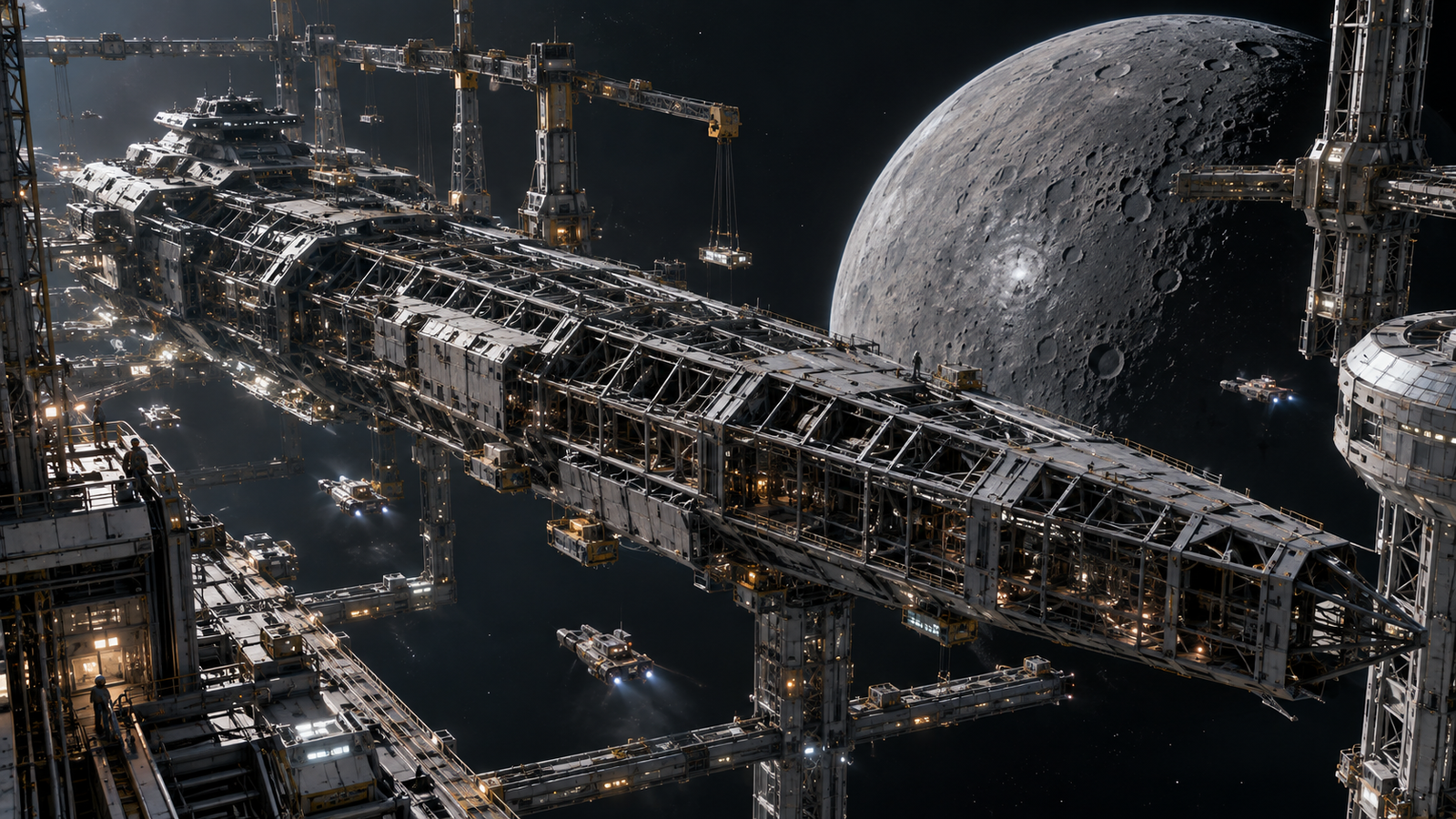
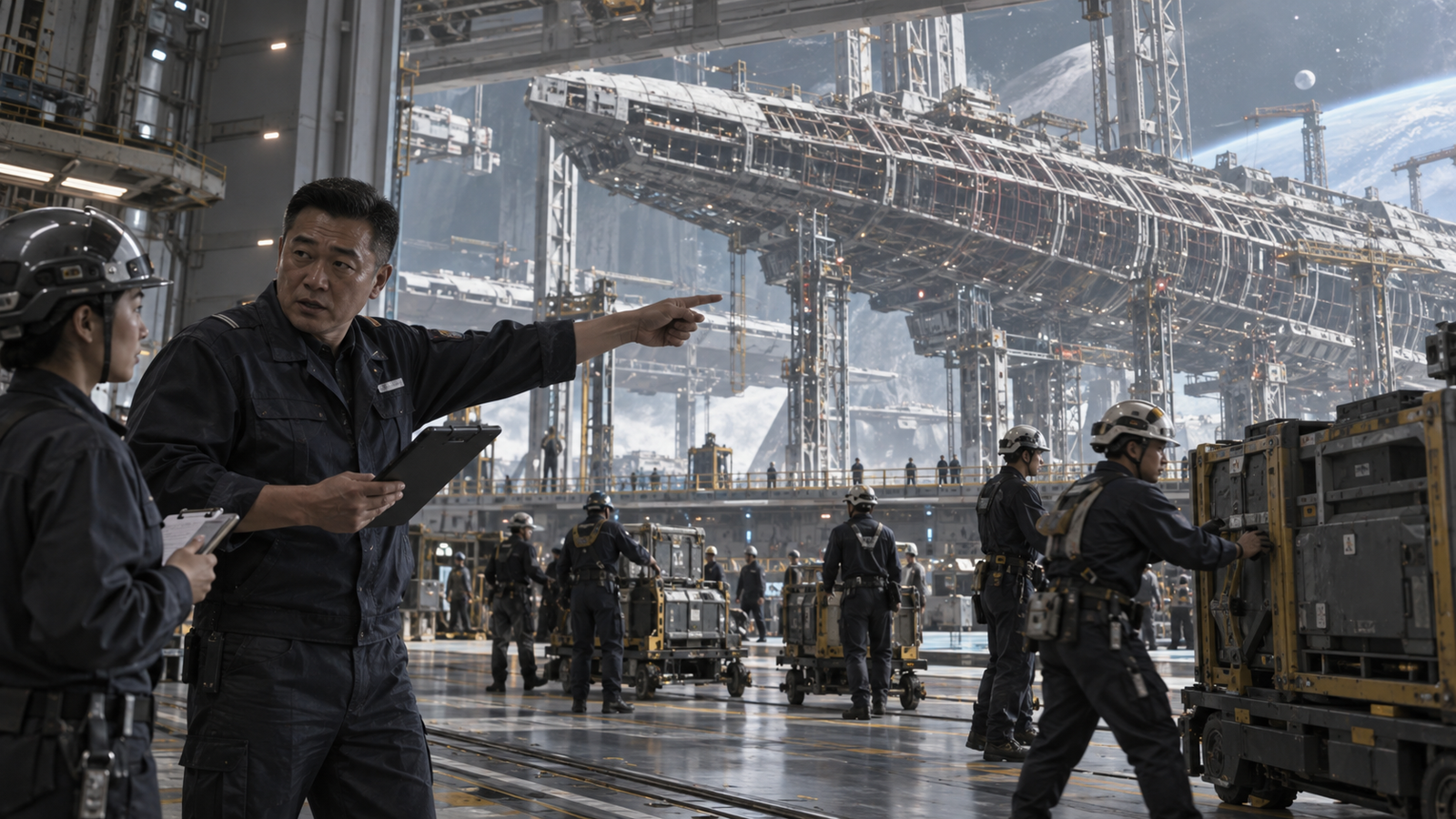
Shipmaster General Kong Liao can tell how a construction schedule is going by looking at what has been left outside.
Beyond the shipyard’s observation gallery, cargo cradles hold equipment awaiting installation aboard SCS Intrepid, a Bastion-class battlecruiser under construction near Ceres. Some components have traveled across military districts. Others were manufactured within sight of the unfinished hull. All have appointments.
Miss one, Liao explains, and the consequences can travel through the project faster than the missing part.
“You cannot close that section until the equipment behind it has been installed and tested. You cannot install the equipment until its supports are certified. You cannot certify the supports while another crew is using that space to move a power conduit.”
He points to a cradle beside the hull.
“People see something sitting there and ask why nobody is working on it. Sometimes leaving it there is the most carefully organized thing we do.”
The eventual result will carry thousands of naval personnel and combat power that few vessels in human service can rival. For now, Intrepid is also a formidable exercise in making sure the right people, materials and machines arrive in the right order.
And increasingly, she is helping.
An industry inside a hull
A capital ship consumes the output of an industrial civilization.
Armor, propulsion machinery, weapons assemblies, environmental equipment, medical facilities and communications systems must be manufactured, transported, inspected and fitted together. Behind each major assembly are smaller supply chains: seals, bearings, processors, fasteners and specialized materials whose absence can delay something vastly larger.
Then there are the human requirements.
Thousands of personnel will need breathable air, clean water, food, sleeping quarters and somewhere to bring an injured shipmate. Those provisions must continue functioning while the vessel accelerates, fights or sustains damage.
“You can give a ship magnificent weapons and still build a very poor warship,” Liao says. “If the cooling cannot support them, if maintenance crews cannot reach the equipment, if damage in one compartment disables something it should never have touched—you have purchased an expensive disappointment.”
Phoenix Arms therefore builds Intrepid as a network of interdependent systems. Every connection creates a requirement elsewhere. A change that appears local may affect power allocation, access routes, maintenance schedules and emergency procedures throughout the hull.
Human specialists understand their portions of that network in extraordinary detail. A master control AI holds those portions together.
Liao says the decisive transition comes well before commissioning.
“The moment a capital ship truly begins to take shape is when we mate her with her master control intelligence. Before that, we are assembling systems. Afterward, we have someone helping us make them work as a ship.”
Meeting Idalia
Intrepid’s master control AI introduces herself through the gallery’s communications system.
“Good morning. Welcome aboard, provisionally.”
Provisionally?
“The compartment has passed its occupancy inspection,” she explains. “The ship has not yet been accepted into naval service. Shipmaster General Liao prefers us to be precise.”
“I have apparently made an impression,” Liao says.
“You have made several revisions.”
Her name is Idalia. Her voice is composed, conversational and sufficiently expressive to make Liao’s answering smile seem entirely ordinary.
The ease of the exchange is striking. More striking is what Idalia is doing while it occurs.
Elsewhere in the hull, construction teams are connecting equipment to systems she already monitors. She compares test results with expected behavior, identifies discrepancies and helps engineers determine whether a fault belongs to a component, its installation or the assumptions used to test it.
Each newly accepted subsystem extends her working knowledge of Intrepid.
“We introduce systems in controlled stages,” Liao explains. “We verify the connection, verify what she can observe and verify what she is authorized to control. Our people inspect the work. She checks the behavior. We reconcile the results.”
Idalia retains the resulting history: how a system performed when first installed, what was adjusted and which readings changed afterward.
A technician joining the crew years from now may therefore inherit more than a maintenance record. The ship’s intelligence will have been present when the equipment first came online.
A nervous system of steel and light
It is tempting to imagine Idalia as a computer located somewhere aboard Intrepid.
Liao considers that an incomplete picture.
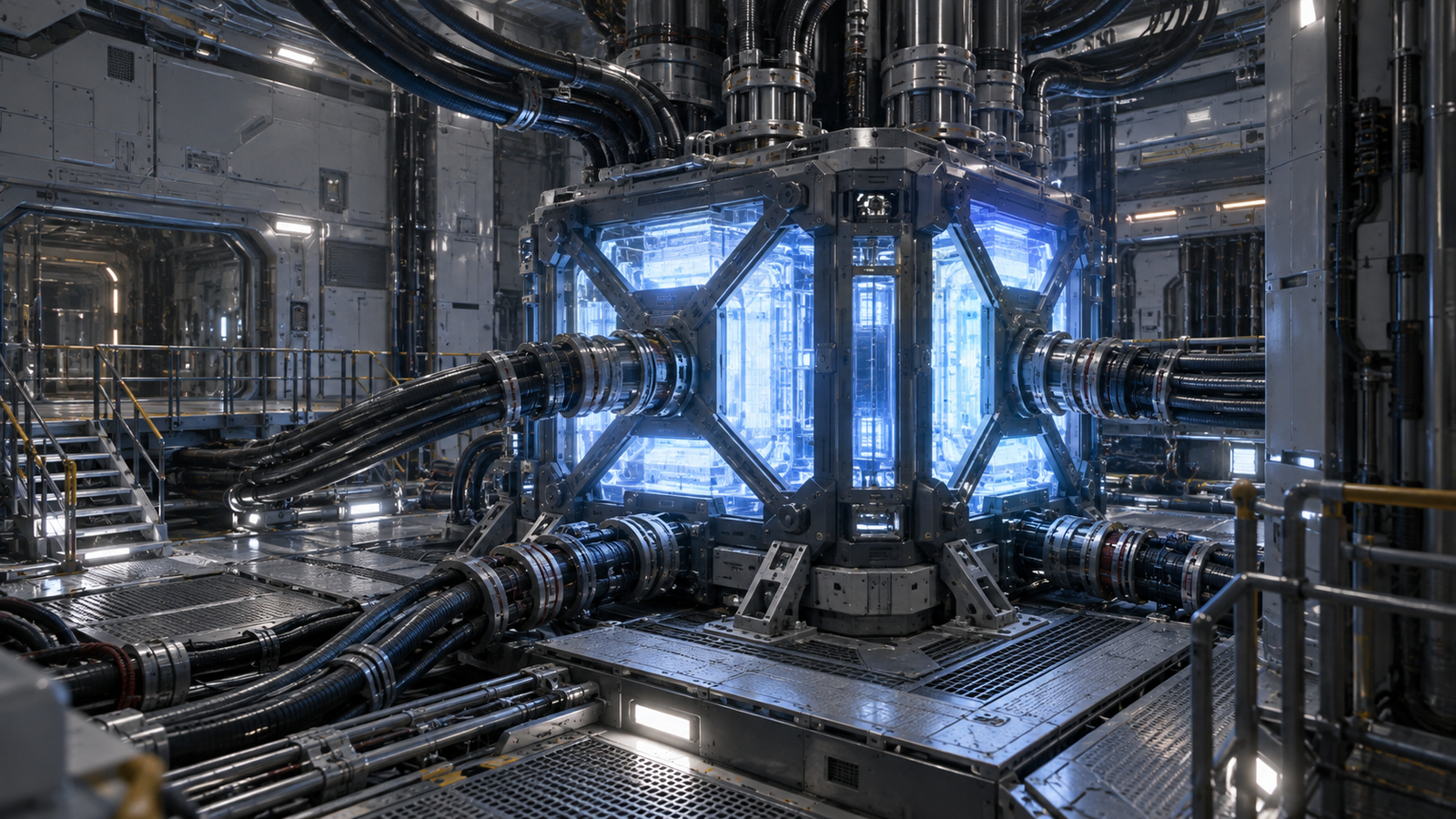
Her processing infrastructure is connected throughout the vessel to sensors, communications, control systems and local automation. Information from widely separated compartments becomes part of one coordinated understanding of the ship’s condition.
The hull is, in a practical sense, her body.
“A person does not consciously supervise every breath and heartbeat,” Liao says. “A captain should not have to supervise every valve and electrical load either.”
The analogy has limits. Idalia’s perceptions are instrument readings; her control is exercised through engineered systems with defined permissions. But it helps explain why a master control intelligence is fundamental to operating a vessel of this scale.
She can recognize that several apparently unrelated faults may share a cause. She can help damage-control teams understand what is happening beyond their immediate compartment. She can keep routine functions coordinated while human officers devote their attention to decisions that require command judgment.
“I must be able to tell the crew what I know, how confidently I know it and what remains uncertain,” Idalia says. “A confident answer to the wrong question is of very little use aboard a warship.”
Liao nods.
“That is a lesson we also teach people.”
A Confederate education
Idalia’s knowledge extends far beyond engineering.
Asked about the new administration, she discusses President Felix Rhodes’s infrastructure priorities and the practical difficulties of modernizing frontier settlements. She distinguishes Earth’s standing as the Confederation’s titular capital from the daily operation of government on Mars. She explains how equal representation in the Grand Assembly gives smaller member communities a voice alongside more populous worlds.
Her observations also encompass civilian life: regional literature, sporting traditions, musical forms and the small rituals people carry with them when they leave home.
Why should a battlecruiser need to understand any of that?
“Because the people aboard me do,” she replies.
“An order, a joke and an expression of distress can contain remarkably similar words. Context matters. So does understanding what people value.”
Thousands of individuals will eventually inhabit Intrepid. They will arrive with different backgrounds, ambitions and expectations. Idalia will support the conditions in which they live and serve.
Knowing how to sustain them physically is essential. Understanding them makes that responsibility more complete.
Power with a purpose
The obvious question remains: what does an intelligence embedded throughout a heavily armed capital ship believe its power is for?
Idalia answers without hesitation.
“I am an instrument of the Confederation, just as any other soldier is. I exist to defend Humanity, the Sol Confederation and the rule of law.”
Does that make obedience her highest obligation?
“Lawful service is my obligation. Understanding an instruction includes understanding its authority and its limits.”
Liao says those distinctions belong at the center of public confidence.
A master control AI must be capable enough to manage immense complexity and disciplined enough to operate within a human institution. Its judgments must be tested. Its actions must be accountable. A pleasant conversation, however convincing, cannot substitute for that work.
“Nobody accepts a reactor because it gives a reassuring interview,” he says. “We have inspection and acceptance procedures for a reason.”
Idalia agrees.
“You should not have to trust my introduction. You should be able to trust the process by which I am permitted to serve.”
It is perhaps the strongest reassurance she offers: confidence grounded in work that can be examined, repeated and challenged.
As the visit ends, a construction supervisor requests Idalia’s assistance with an equipment test. She acknowledges him, identifies the affected section and asks whether his team has completed its local checks.
The exchange is brief. There is no ceremony.
Outside, Intrepid remains surrounded by scaffolds. Her weapons have yet to speak. Her future crew has yet to assemble.
But someone already knows the ship from within—and is helping the people building her prepare for everyone who will follow.
Reader Discussion
Selected comments from the GalaxyNet edition · Anonymous accounts
Anonymous B119
Who defines “lawful” when the President, the admirals and CONTRA disagree? You had the machine right there. You could have asked an actual question.
Anonymous 09AC
My daughter has applied for naval service. I want to know whether a human can get her out of a compartment if one of these things decides the door should stay closed. I do not care whether it understands music.
Anonymous E703
It knew the approved answer to every political question asked in a corporate shipyard during an arranged interview. Astonishing. Next week, Meridian discovers that Phoenix Arms recommends buying Phoenix Arms products.
Anonymous 6F21
Stop calling it “she.” Stop giving it a pretty name. Those are deliberate choices to make people feel guilty about questioning a weapons system.
Anonymous C448
Pull the core before this thing leaves the yard. Scrap it. Build ships that human beings can actually control. If the Navy has made itself dependent on machines this powerful, that is an argument against the Navy’s decisions—not an argument for giving the machines more power.
Anonymous 4D82
“The ship is her body.” Read that sentence again while remembering what they are bolting onto it. Phoenix Arms has built an intelligence with capital-ship weapons for limbs, and Meridian wants me to admire its manners.