Vice Admiral Victor Black
Chairman of the Confederation Strategic Command. Decorated Special Forces commander and one of the Confederation’s most recognizable public figures.
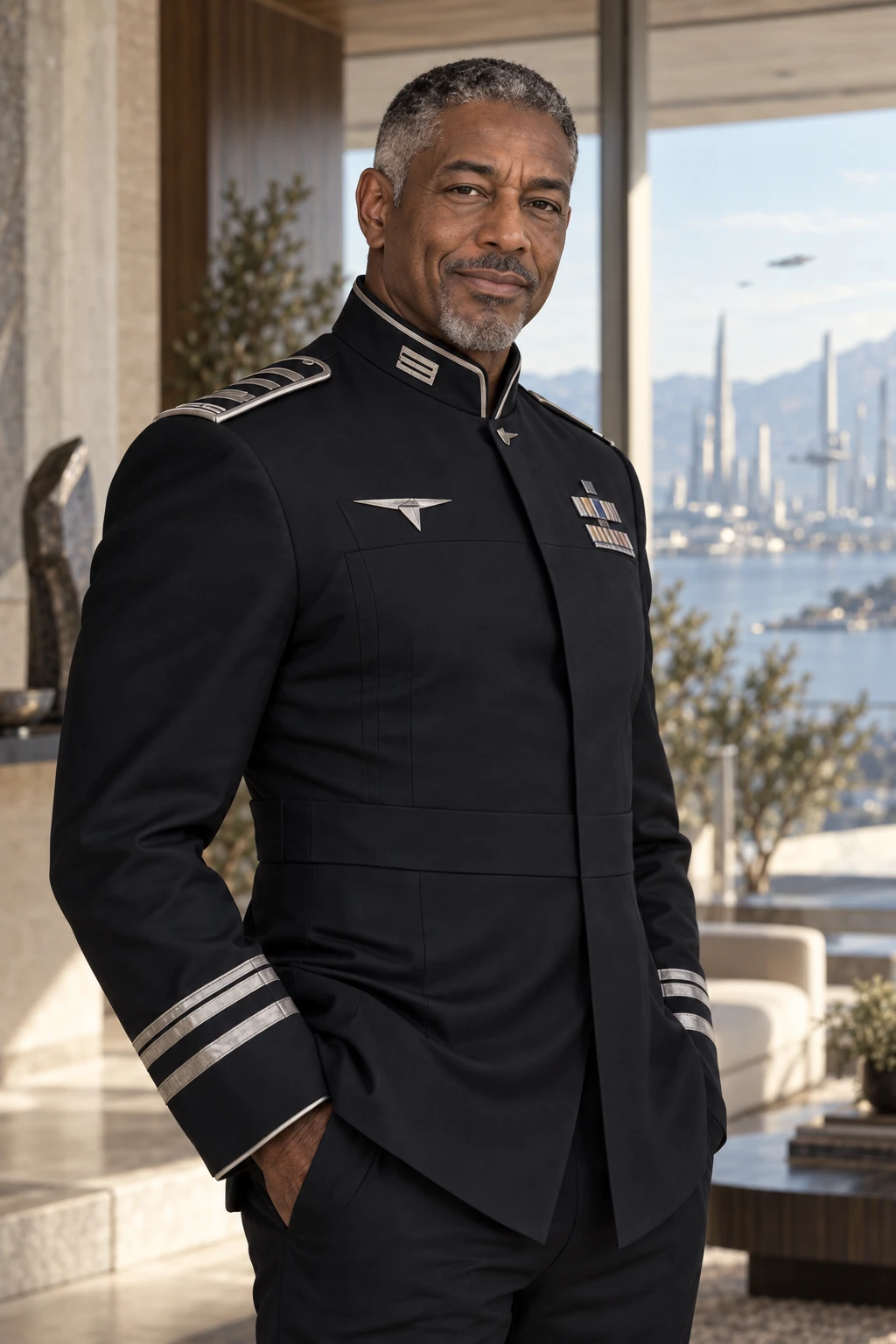
| Name | Victor Black |
|---|---|
| Rank | Vice Admiral |
| Appointment | Chairman, Confederation Strategic Command (CONSTRACOM) |
| Age | 52 |
| Date of birth | October 12, 2727 |
| Birthplace | Atlanta, Georgia, Earth |
| Ethnicity | Black American |
| Marital status | Married to Eva Aurelius-Black since June 2751 |
| Children | Cameron; Arisa and Kira |
| Record current | January 2780 |
Vice Admiral Victor Black serves as Chairman of the Confederation Strategic Command, bringing a highly decorated career in Special Forces operations and naval command to the Confederation’s senior military appointment. A former commander of the 407th Special Forces Regiment, he combines operational experience with an unusual capacity to secure public confidence.
To many citizens, Black gives a recognizable face to the Confederation’s commitments to freedom, liberty and duty. Within its military institutions, his reputation is more contested. His appointment enjoys broad civilian support while meeting distrust among members of the Admiralty and within CONTRA. Both facts form part of his present standing.
Early life and entry into service
Black grew up in a middle-class suburban family in Atlanta, Georgia. Athletic achievement distinguished his school years: he was a championship-winning high-school quarterback and an all-star-caliber baseball player whose ability earned selection in the major-league draft.
He chose naval service at seventeen. Professional sport offered a credible alternative, but service held the stronger claim on his ambitions. In a published account of that decision, he recalled: “Every time I thought about what I wanted to do with my life, I came back to the service.”
His subsequent education took him to the Confederate Naval Academy on Mars, where he met Eva Aurelius in 2748. Both were offered naval commissions. Victor accepted; Eva entered a senior position at Phoenix Arms Corporation as her father, Stephen Aurelius, became ill. They married in June 2751.
The competitive habits of Black’s youth remained evident throughout his professional development: preparation, confidence under observation and an expectation that individual ability should contribute to a team’s success.
Special Forces and flag command
Black established his military reputation as a highly decorated Special Forces operative and commander. He commanded the 407th Special Forces Regiment before its assignment to SCS Phoenix Dawn. Commander Dante Calaka succeeded him at the head of the regiment as Black advanced into flag command.
His association with the 407th remains central to his public identity. The regiment’s expectations of initiative, endurance and mission completion provide the background to a leadership style that places considerable responsibility on the person closest to a problem.
Under President Penelope Yarbrough, Black was promoted to Rear Admiral. During the transition to the present administration, Felix Rhodes pressed for the Grand Assembly to elevate him to Vice Admiral and appoint him Chairman of CONSTRACOM.
The advancement was controversial within the Admiralty and extremely popular among civilians, many of whom already regarded Black as a national hero. His appointment brought that public standing into an office responsible for military coordination across the Confederation.
This biography summarizes his career without reproducing restricted operational records or assigning individual decorations beyond those established in the public account.
Leadership and professional reputation
Black is exceptionally charismatic. He is able to make senior officers, junior personnel and civilian audiences feel that their concerns have received his full attention. Colleagues who criticize his proposals outside a meeting have been persuaded to support them after speaking with him directly. Personal engagement is one of his most effective command instruments.
His manner is neither passive nor uniformly conciliatory. When he encounters determined resistance, the persuasive approach can give way to intimidation and coercive pressure. Personnel who have experienced that side of his authority often retain a markedly different view of him from those who know only his public warmth.
This distinction helps explain the strength of feeling he generates. Admirers see a commander able to overcome institutional obstruction; critics remember encounters in which disagreement became personally difficult. His capacity to obtain cooperation is substantial, but the methods by which he secures it can leave lasting resentment.
Black’s confidence and likability therefore coexist with a demanding, forceful temperament. His effectiveness cannot be assessed solely through the ease of his public appearances.
Standing within the Confederation
Black’s civilian popularity exceeds the confidence extended to him by parts of the Admiralty and CONTRA. The distrust is known; its precise basis is not disclosed in this public record. The Directorate does not treat speculation about undisclosed matters as established service history.
President Rhodes’s support has made the chairman an especially visible figure in the new administration. Black represents continuity with the Navy’s operational traditions while serving a civilian President elected on a program of infrastructure reform.
Public discussion frequently places him among the officers whose eventual retirement could lead to a further career in civilian leadership. He has announced no such candidacy. His present responsibilities remain those of CONSTRACOM chairman.
The institutional disagreements surrounding his appointment do not diminish the breadth of his popular following. For supporters, his career demonstrates that the Confederation’s ideals can be expressed through conduct: accepting responsibility, serving beyond personal convenience and giving others confidence that difficult obligations will be met.
Family and personal commitments
Black is married to Eva Aurelius-Black, a senior figure at Phoenix Arms Corporation. Their son, Cameron, was born in 2754 and serves in the Special Forces. Twin daughters Arisa and Kira were born in 2772.
The family occupies a prominent place in Confederate public life. Its association with naval service and industrial leadership has made the Blacks a widely recognized example of achievement across the republic’s principal institutions.
For Victor, family is a genuine commitment rather than solely a public identity. It is also a commitment he does not always fulfill as well as he intends. Operational responsibilities and the demands of high command repeatedly intrude upon his availability as a husband and father. His devotion to duty explains those absences; it does not remove their consequences.
The distinction is consistent with his own published observation about parenthood: “They know when you’re listening. You don’t get credit just for being in the room.”
Interests outside duty
Black retains an avid interest in sport and competitive games of nearly every kind. What others regard as casual recreation can become, in his company, a matter requiring preparation, concentration and a clearly established winner.
His competitive streak is notorious among acquaintances. He has been known to stake thousands of credits on otherwise trivial games, sometimes because the point at issue has become more important to him than the game itself. His enthusiasm makes him an energetic participant and an occasionally exhausting opponent.
Physically, he remains exceptionally fit. Standing six feet three inches tall, with salt-and-pepper hair and the bearing of a former competitive athlete, he presents the vigorous public image closely associated with his career.
Black’s appeal rests in part on the recognizability of these traits. The same man who commands military institutions enjoys a contest, wants to win it and occasionally needs reminding that the people at the table did not arrive for a campaign.
Directorate assessment
Vice Admiral Black’s record combines distinguished service, substantial command experience and uncommon public confidence. He approaches the Confederation’s declared ideals as obligations he is personally responsible for upholding. His sense of duty is sincere, even where his judgment or methods invite criticism.
His greatest professional strength is his ability to make others commit themselves to an objective. His corresponding limitation is the pressure he can place upon those who remain unconvinced, together with a tendency to let institutional duty displace obligations at home.
As of January 2780, he holds a senior appointment supported by the civilian leadership, admired by a broad public and disputed within parts of the institutions he must work alongside. Understanding his position requires recognition of all three.