The Long Horizon
Felix Rhodes entered office promising that the Confederation's next great project would be built, negotiated and maintained—not conquered.
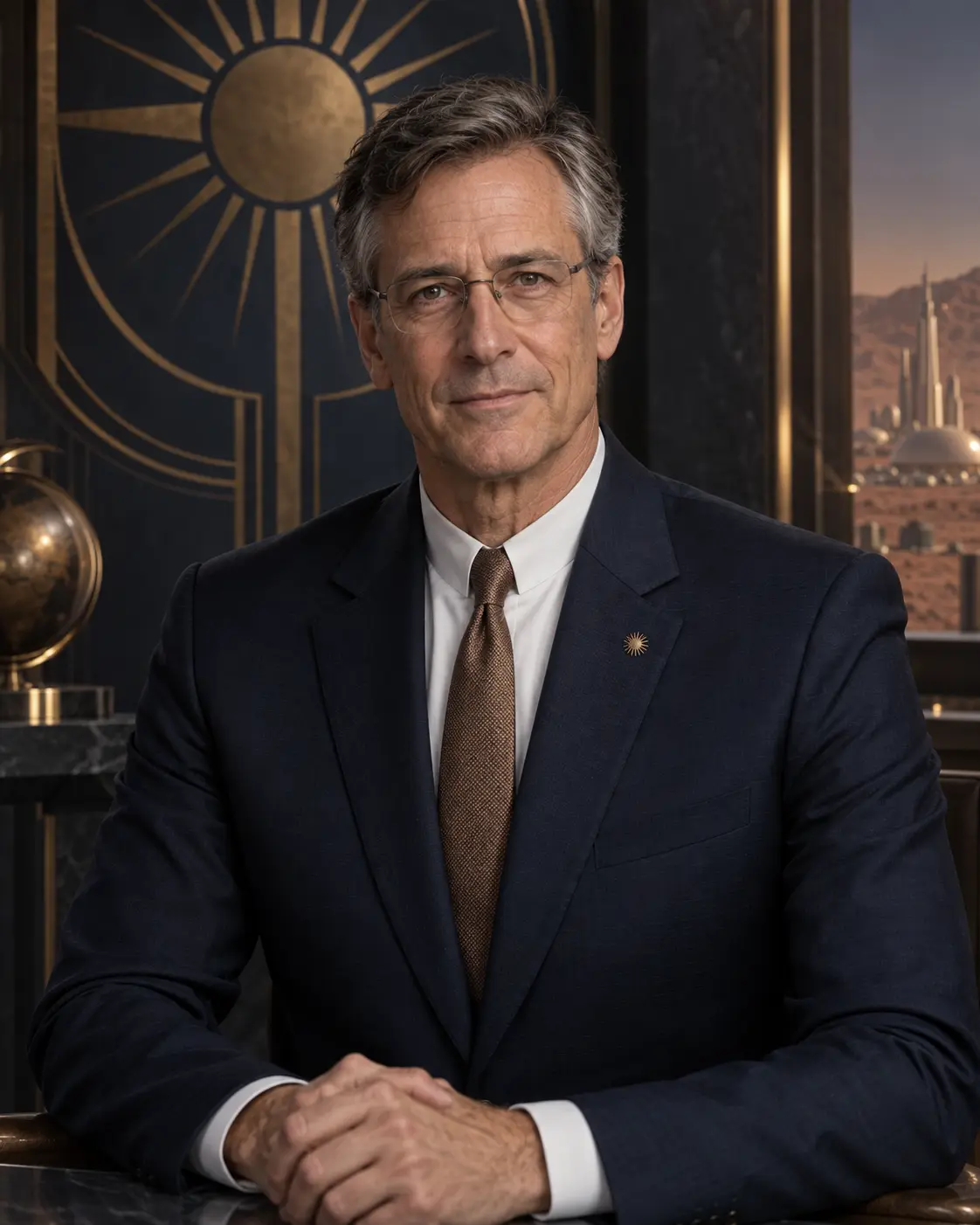
On the corner of President Felix Rhodes's desk sits a photograph of his grandchildren.
He placed it there himself, at exactly the angle a visiting officer will notice before taking a seat. The choice is affectionate. It is also tactical.
“Generals find it reassuring,” Rhodes says, looking over his horn-rimmed glasses. “They expect a grandfather to be sentimental.”
He allows the observation to hang for a moment, then smiles.
At sixty-one, Rhodes has spent a career encouraging powerful people to mistake patience for softness. He has never worn a military uniform. He has never commanded a ship or held a weapon in public life. His rise rests on a conviction he repeats with the calm of a man stating a physical law: the right sentence outweighs any fist.
The Grand Assembly elected Rhodes in November 2779. He assumed the presidency on 5 January 2780, beginning the single nonrenewable five-year term allowed by the Confederation's constitutional order. He arrived as an infrastructure reformer, convinced that a republic spanning hundreds of systems must prove its competence not only at the center, but wherever a citizen opens a tap, boards a transport or waits for a distress signal to be answered.
His admirers see a statesman suited to the Confederation's next stage of development. His opponents see a civilian idealist assuming office while the Holy Solar Empire grows stronger beyond the Centauri frontier.
Rhodes sees a room that can still be persuaded.
The hydrology administrator
Rhodes mentions Ceres constantly.
Before the Assembly committees, district delegations and executive offices, he was a hydrology administrator responsible for keeping water moving through sealed habitats and industrial systems on the dwarf planet. It was essential work, highly technical and almost entirely unromantic.
That is precisely why he brings it up.
“I used to count leaks on Ceres,” he told a gathering of senior admirals during his first week in office. “You may therefore imagine my delight at discovering that government contains so many of them.”
The line earned the expected laughter. It also encouraged several people in the room to underestimate him, which aides familiar with Rhodes describe as a recurring and carefully cultivated result.
He does not conceal his calculation. Administrative work taught him that decisions are made before the formal meeting, that budgets reveal priorities more reliably than speeches and that the most important person in a room is often the one who knows which valve cannot be allowed to fail.
“A water system does not respond to intimidation,” Rhodes says. “Neither does a transport network. You can shout at either one and remain thirsty in exactly the same way.”
From Ceres, Rhodes moved through progressively larger civil and political responsibilities, building a reputation for mastering dense technical briefs and persuading opponents that his preferred outcome had been their idea. He became a career statesman without adopting the bearing of one. The jokes remain dry, his suits deliberately ordinary and his recollections of Ceres just frequent enough to suggest he has forgotten how far he has traveled.
No one close to him believes he has forgotten anything.
Two fleets come home
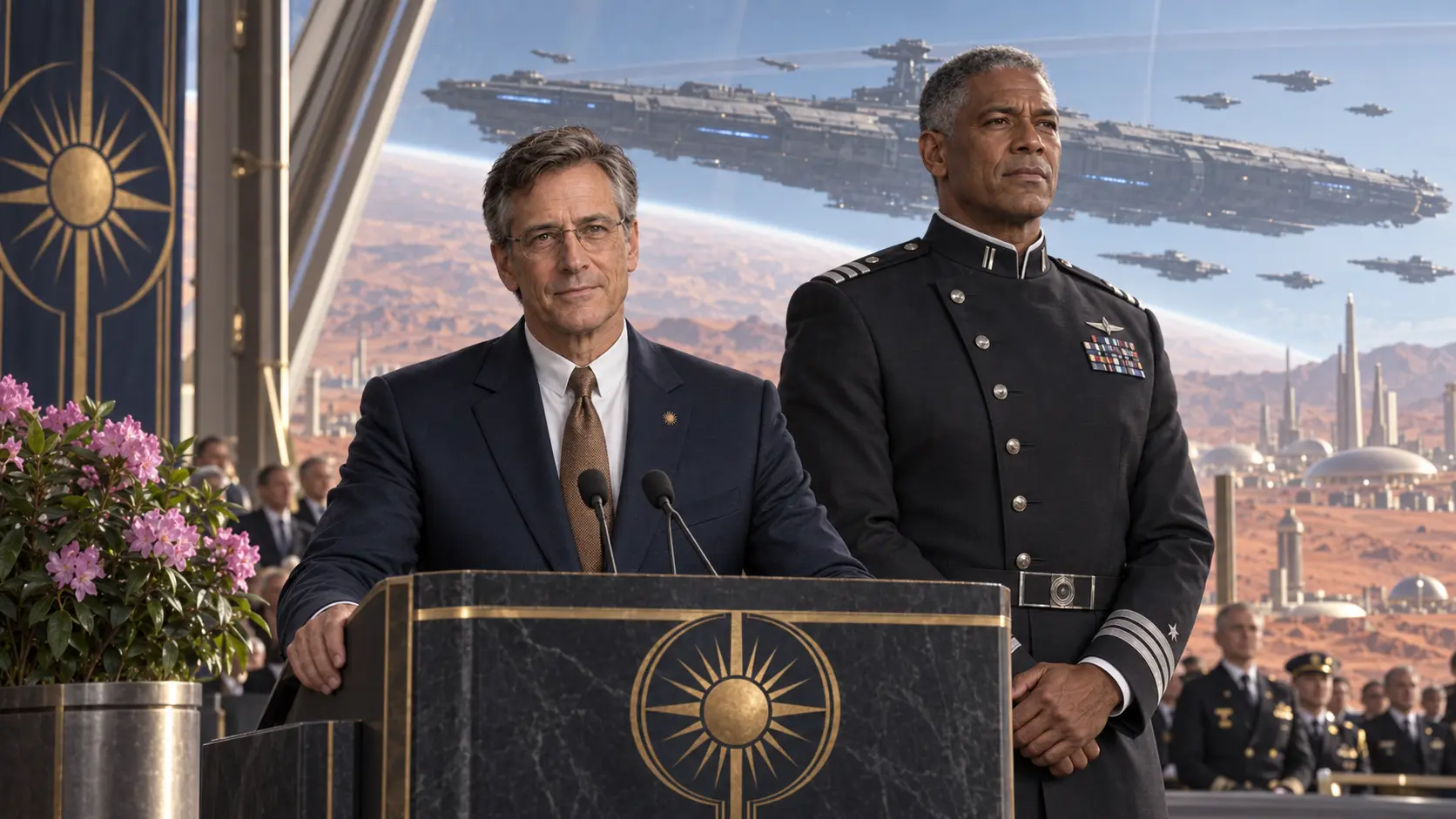
In celebration of Rhodes's inauguration, the First and Second Fleets returned to Sol. Their arrival filled the space above Mars with the most imposing display of Confederate naval power assembled in the home system in years.
The official purpose was ceremonial: the Navy presenting itself to a newly installed civilian commander in chief. The practical purpose was maintenance. Ships rotated through refit berths, stores were replenished and overdue systems were opened for inspection while crews received leave.
The distinction matters. The fleets were present in unusual strength, but they were not assembled on a war footing. Several vessels entered the inaugural review with magazines awaiting replenishment or major systems scheduled for overhaul. The home system held more hulls than usual and fewer ships ready for immediate, full-intensity combat than the ceremony suggested.
Vice Admiral Victor Black, chairman of CONSTRACOM, rejects the suggestion that the review was merely theater.
“Ceremony is how a republic reminds armed institutions whom they serve,” Black says. “There is nothing ‘merely’ about that.”
He also concedes that Rhodes understood how many objectives the same order could serve.
“The President wanted the public to see the Navy together,” Black says. “He wanted the crews to see one another, and he wanted the maintenance commands to have every senior officer in the same system while the work was being done. Felix rarely asks for one thing when the same order can accomplish three.”
The resulting images already define the new administration: Rhodes at a podium, Black beside him and SCS Excelsior suspended beyond the terrace. Civil authority, military power and a famous flagship occupy the same frame. The picture conveys readiness more cleanly than any dockmaster's report could—and Rhodes knows the difference between those two documents.
Building the frontier inward
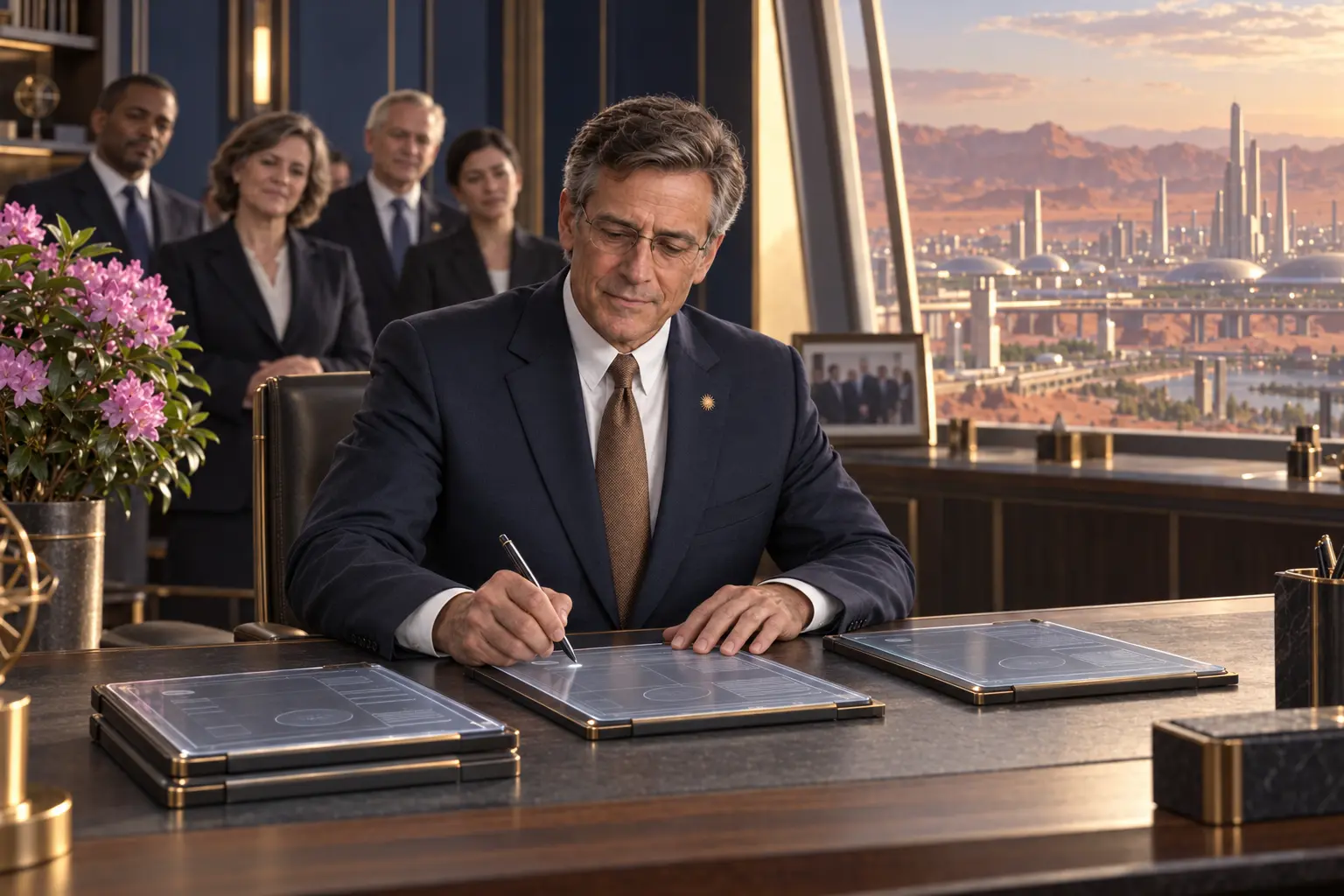
Rhodes was brought into office to modernize the Confederation's physical systems. His plans target portions of Spica and Ursa Major for extensive development: power grids, water and habitat works, navigation infrastructure, emergency depots, communications relays and stronger connections to the interdistrict freight network.
His political argument is simple. Membership in the Confederation should mean more than a flag, a tax schedule and the occasional arrival of a patrol ship. People at the edge of controlled space should encounter the republic through institutions that work every day.
“Distance is a geographic fact,” Rhodes says. “Neglect is a policy choice. We should stop confusing the two.”
Spica's Academy complex makes the district indispensable, while piracy along its outer rim tests the reach of local authorities. Ursa Major combines major industry with a political culture suspicious of central power. Rhodes believes infrastructure can answer both problems by making distant communities more resilient and more visibly connected to the whole.
The opposition's sharpest objection concerns the Holy Solar Empire. With Imperial strength growing beyond the Centauri frontier, critics argue that Rhodes's campaign for a less military-centered Confederate identity mistakes a long peace for a permanent one. One Assembly opponent summarized the charge in a line now repeated across GalaxyNet: “Pipelines do not deter Warsingers.”
Rhodes's reply is characteristically literal.
“Fleets deter Warsingers,” he says. “Pipelines help determine how long those fleets can remain where we need them.”
Black agrees. “Every admiral would like another squadron,” the chairman says. “But a squadron without fuel, repair capacity, communications and places to protect is an expensive way to orbit a problem. Civil investment changes what the Navy can do when it gets there.”
The President and the admiral
The partnership between Rhodes and Black is already the most closely examined relationship in the new administration.
Rhodes treats the admiral as a protégé while acknowledging that Black's career—from a seventeen-year-old recruit and championship athlete to decorated commander and CONSTRACOM chairman—required little presidential invention. Their public appearances have encouraged a more consequential interpretation: that Rhodes is grooming Black to seek the presidency after retiring from military service.
Rhodes does little to suppress the idea.
“The Assembly will choose my successor,” he says. “That is its constitutional duty, and I would not presume to perform it early. I will say that public life should not be deprived of capable people simply because they have already given it one career.”
Black is less expansive. “I have a Navy,” he says. “It is not a part-time obligation.”
Opponents see a calculated transfer of prestige: a civilian President borrowing the public confidence attached to the chairman, while placing the likely next candidate beside him at every important moment. Supporters see continuity between a statesman who understands systems and an admiral who understands what those systems must ultimately protect.
“He asks what breaks first, what fails next and what should have been built ten years earlier,” Black says of Rhodes. “That is a useful habit in a President.”
It is also how Rhodes conducts politics. He rarely defeats an argument by striking at its loudest point. He changes the structure around it until the room arrives somewhere else.
The calculated sentimentalist
Late in the interview, Rhodes returns to the photograph of his grandchildren.
The affection is genuine. So is the staging. He knows that some generals interpret the picture as proof that the President is gentle, domestic and perhaps unprepared for the harder arithmetic of security. He keeps it in their sight because their assumptions reveal what they are willing to say in front of him.
“People are often most informative when they believe they are being reassuring,” Rhodes says.
His critics may be correct that the next five years will test a civilian administration against dangers infrastructure cannot negotiate away. Rhodes does not dismiss the Empire, and he has not proposed disarming the Navy. He argues instead that the Confederation is mature enough to define strength through more than the number of hulls it can place over a world.
He has one term to prove it.
The First and Second Fleets remain in Sol, scattered through refit cycles beneath the inaugural pageantry. Legislative drafts move between the executive offices and the Grand Assembly. Survey teams in Spica and Ursa Major are converting campaign promises into routes, costs and construction timetables.
On the desk, the grandchildren continue smiling at every visiting admiral.
“The right sentence outweighs any fist,” Rhodes says. “The difficulty is knowing which sentence, and having the patience to wait until the room can hear it.”